Why beetles pile up on the sunny side of your house every fall
They aren't eating your house or moving in to stay; they're looking for a warm crack to spend the winter in, and your south wall is the best-lit place on the block.
October 14, 2026 · 4 min read
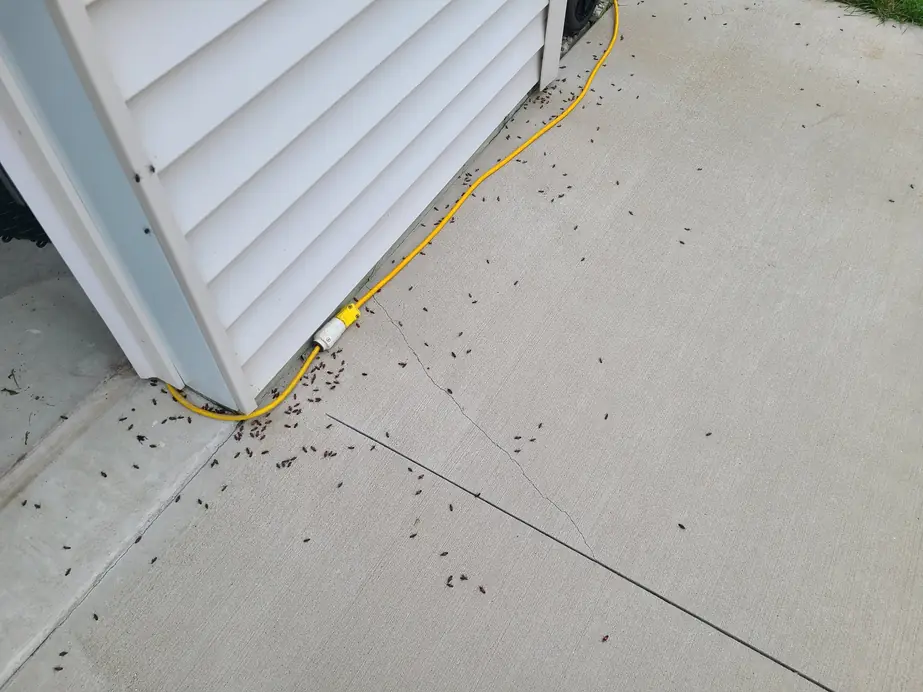
Sometime in the fall, usually on the first run of cool nights followed by a bright afternoon, you walk out and the siding is crawling. Dark insects are clustered along the base of the wall, around the window frames, up the door trim and across the concrete step. By the next day there are more. If you've lived in Flint or anywhere in Genesee County for a few autumns, you've probably seen it.
Two culprits show up most often. Boxelder bugs are black with reddish-orange markings on the back. Asian lady beetles are rounder, ranging from orange to red, sometimes spotted and sometimes plain. They're different insects, but they do the same thing this time of year, and for the same reason. They're looking for somewhere to spend the winter.
Why your house, and why that wall
As nights get cold, these insects stop feeding and start searching for a sheltered crack. A sunny wall is the best advertisement they have. South and west faces soak up the afternoon sun, and the siding stays warm after the air has cooled off. Warmth tells them they're close to something that holds heat, and a building is exactly that.
Once a few settle, more tend to follow. The cluster you see on the siding isn't random; each beetle that lands makes the spot more attractive to the next one. That's why it can go from a handful to a crowd in a couple of days, and why one wall can be covered while the shaded north side is nearly empty.
Where they came from matters too. Boxelder bugs live on boxelder trees and other maples, especially the seed-bearing ones, so a house near one of those trees gets more than its share. Asian lady beetles spend the summer eating aphids in trees, gardens and fields, and when the harvest is done and the food runs out, they look for the nearest tall, warm surface. A house with a stand of trees nearby is on the route.
What happens after they get in
The ones you see on the outside are the lucky ones for you. The rest are already slipping under siding edges, behind trim, into attic vents, around utility lines and into the gaps around window and door frames. Inside the walls they go dormant. Then on a warm day in January, when the sun hits that same wall and the wall cavity heats up, they wake and wander. That's when people find them on windowsills, in light fixtures and in the corners of the living room, wondering where they could have possibly come from.
These insects are what the trade calls occasional invaders. They don't chew your framing, they don't breed in the house, and they're not a hygiene issue. They're a nuisance, and a persistent one. A few things make the nuisance worse than it needs to be: crushing them tends to leave stains and an unpleasant smell, so a vacuum is the better tool for the ones that get inside.
What helps on your own
- Seal in late summer, not after they've arrived. Caulk the gaps around windows, door frames and utility lines while the wall is still empty.
- Fix torn screens and add or replace door sweeps. A gap at the bottom of an entry door is an open invitation.
- Check the vents. Attic and soffit vents should have intact screening, and so should any gable openings.
- Look at the trim where siding meets the foundation or the slab. That joint is a favorite spot.
- Vacuum the ones that get inside instead of swatting them, and empty the vacuum outside afterwards.
Where a program makes a difference
Sealing does a lot, but no house is perfectly tight, and older Flint houses have plenty of seams. This is where timing starts to matter. All-N-One Pest Control's insect control service covers boxelder beetles and Asian beetles along with ants, centipedes, earwigs, fleas, roaches, spiders and other occasional invaders, and their preventative program is built around the calendar.
The preventative program runs seven outdoor treatments from April through October. It covers ants, earwigs, box elders, Asian beetles, spiders, wasps, yellow jackets and other occasional invaders. The idea is that by the time the beetles are looking for a place to winter, the perimeter of your house has been treated all season long and isn't waiting for the problem to show up first. If treating inside is needed, their program says inside treatments are provided at no additional cost.
They're upfront about the limits too. Give each service seven to ten days to reach maximum effectiveness, and if you're still seeing a problem after that, call and they'll come back and treat the area again at no additional cost. They're also clear that fleas, roaches, bed bugs and pantry pests can't be prevented the same way, because those get carried in by people, pets, products and furniture. If you see one of those, call right away.
Winter service is available on request at the same monthly service charge, and a customer who stays on the program is automatically invited back the next year with no cleanout charge.
What to do right now
If the siding is covered today, seal what you can reach, vacuum what gets inside, and don't panic. They're not going to hurt the house. If you want them handled before next fall, or you'd like a technician to look at where they're getting in, call All-N-One at 810-736-9513 or stop by the shop at 4294 Richfield Road in Flint.
All-N-One Pest Control, 810-736-9513
Call 810-736-9513More articles
Yellow jackets in the wall or the ground: what to do and what to leave alone
A nest you can't see is more dangerous to poke at than one hanging from the eaves, and most of the common fixes make it worse.
Bed bugs after a hotel stay or a dorm move: how they hitch a ride
Bed bugs don't care how clean your place is; they care about getting carried in, and the fix starts with knowing how that happens.